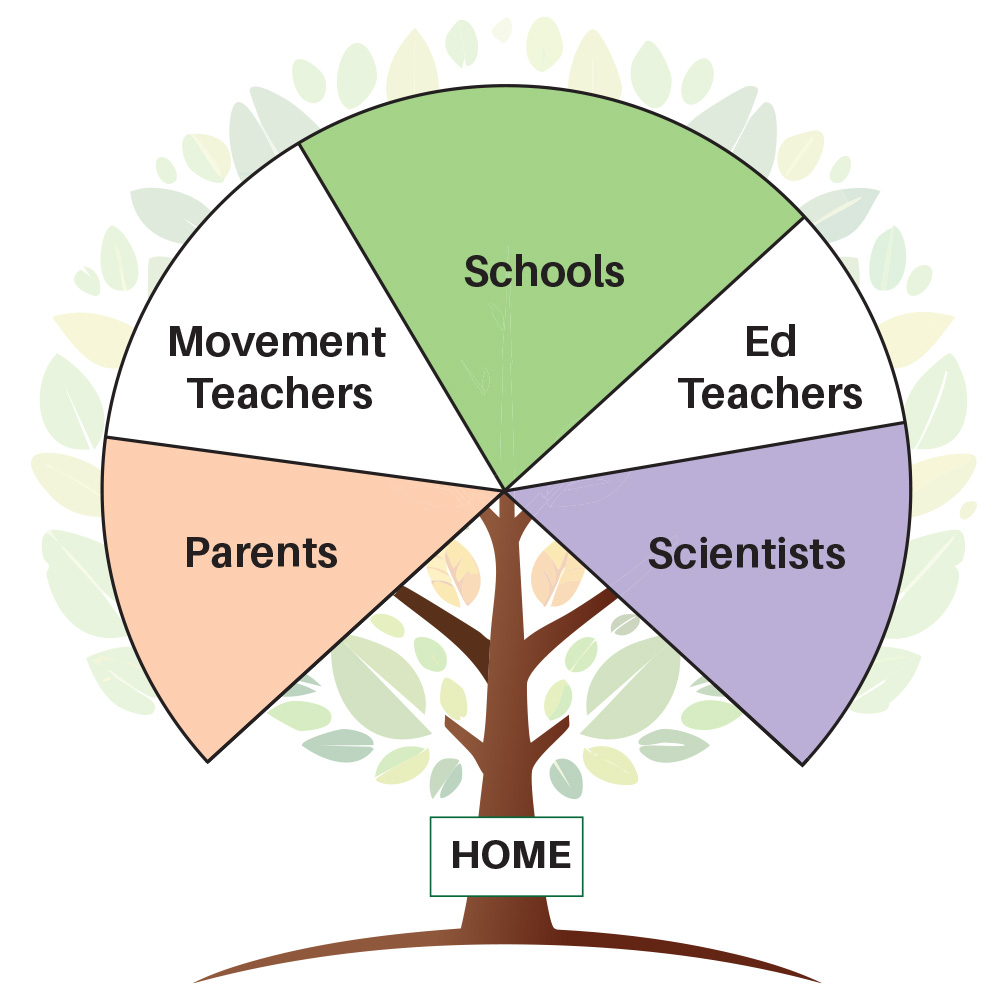

WTM unites
cognitive development,
movement research,
& behavioral psychology.
Here’s How
Movement Becomes Consciousness
Behavior creates motion. Intention, attention, and motion search for unity and form patterns. Patterns find successful functions. Functions (bodily) influences perception. And perception contributes to consciousness. The WTM method helps participants develop their Sensory Body SB through an awareness of body sensations, motion, and a new type of sense perception – approaching motion as a form of intelligence (See Tips for Research below)
Note: Motor “patterns” are different than muscle memory. See more below, “Methodology”
Q & A
(√) Can You Give Me a Quick Overview of WTM? click ->
History After forty years of researching the human body to consciousness, this program (serendipitously) was created. The Wellness Through Movement (WTM) program was designed and tested in the trenches of five elementary schools (2006-2014) with the Kohala communities of the Big Island. Kohala Elementary, a pilot school, is a public school of below-poverty classes in the rural areas of the Big Island.
Catherine Mitchell’s research, before working in an elementary school, involved forty years of treatment with chronic conditions. Muscular-skeletal patterns were analyzed (through the Feldenkrais® Method entitled Functional Integration®) in relationship to behavior and systems. Though speculative, people with chronic conditions improve when awareness of body ownership and motor patterns related to condition was reintegrated.
Methods
The WTM movement lessons of Advance Lessons are based on the Feldenkrais® Methods and developmental movements. The main idea of the movement lessons is to learn to sense guidance from the Sensory Body is were put into an elementary school level physical education program.Part Iand Advanced Lessonsphysical education programs meet some of the standards. These standards are set for United States Elementary School Physical Education programs.
Introductory and Advanced Lessons
(√) Were Lessons Tested & Proven Effective? click ->
Yes. Twenty years of research and testing went into the WTM program. An additional twenty years went into the study of chronic conditions and movement based on the Feldenkrais® Method. Here is a testimonial from the principal of our pilot school, Kohala Elementary.
Focus of the programs was to enhance both body ownership and re-educate sensorimotor patterns. Strategies were tested and revised between 2006-2018 in a public elementary school with children from multicultural and below poverty backgrounds. Over 500 children (in groups of 6-22 participants) and ages 5-10 years old experienced these strategies:
- Developing awareness in the organic nature of the body and what it wants to do without interfering
- Developing awareness of the presence of a physicalness in relation to hearing
- Developing awareness of a synergistic attention, sensing your body while attention is outside yourself
- Developing awareness of the details in parts and spaces of bodily organization
- Developing awareness of to physical changes relate to psychological and cognitive changes
- Developing awareness in the relationships between the organization of movements in the body and behavioral patterns
Educational Institutions Involved
Kohala Elementary School Principal (pilot school)
• Garcia, Danny – and the Kohala Elementary School parents and teachers (WTM Pilot School 2009-2019)
• Souza, Art – Superintendent of the (Big Island) Hawaii, Hawaii, (2006-2019)
Hawaii Preparatory Academy (2005 – 2007)
• Jones, Susie – P.E. Teacher, Hawaii Preparatory Academy, (2005- 2007)
Parker Elementary School (2011)
• Rohr, Donna – Movement Teacher, Parker School, (2011)
• Polhemus, Heather – Principal Parker School, (2006-present)
Reviewers
O’Connor, Joyce – Special Needs Teacher at a juvenile correction center in Alaska and mother (2020 – 2023)
• Sanford, Cherry – Parker School Elementary, and mother (2020 – 2023)
Details of Chronology Testing
Methodology that Affects the Brain from the Body
(√) What is “Movement” in WTM? click ->
Motion as an Intelligence
Some people must run to think, walk to listen, or move to talk. Movement is not merely a mechanical action; it is the vehicle of intelligence. Movement cultivates perception, attention, and executive functioning. (Clark, Schumann, and Mostofsky, 2015). It is the movement that creates the cultivation of perception. Some scientists may label the cultivation an aspect of “body ownership.” (Erhsson, H. H., 2012) In this context, the “intelligence” will be called the “Sensory Body (SB).” Movement of the breath is the ultimate intelligence. It images creates the synergy between perception, attention, and motion.
Main Points to the Movement
We Use Movement as a Thinking Intelligence
First, development maps out the body through motion and attention. The human being uses movement to explore spatial awareness. Spatial awareness is often thought of as external, yet in movement, it is both internal and external. Structure and motion maps out sensations into a living presence, that it a sense, an action of character. The character of this action forms the self.
“Signals from this sensory orchestra are sent by afferent nerves through the spinal cord to the somatosensory, motor, and parietal cortices of the brain, where they continuously feed and update dynamic sensory-motor maps of the body. This major intelligence of the body [this inner teacher] has missed the attention it truly deserves.” (Smetacek & Mechsner, 2004, p. 21).
The structure and sensations “maps” motor patterns (Ehrsson, 2005) created by behavior. These movement maps develop a sense of self is known by the Sensory Body (SB), however, is hidden from awareness. Even though hidden, the level of sensation frequencies in the motor patterns molds the trajectory of development with intentionality.
We Start a Lesson with Movement and Spatial Awareness
To begin a lesson, start with spatial awareness outside of the body. Through movement, narrow the attention in space through the senses. First, attention is outside the body. Then it moves to inside the body. When inside the body, movement is used to feel on tobody parts move in relation to each other.
We Compare the Changes in Attitude to Changes the in Physical Structure
In WTM programs, through movement games, children’s attention is pointed towards changes in their bodies to changes in their moods. In other words, they feel where in the body the attitude changed. Movement is not an exercise to achieve an action, but a tool to explore awareness.
The SB bridges information from the motor, sensory, and memory association areas of the body and brain. This is crucial to understanding how one thinks and behaves. The experience teaches awareness of how this synergy shifts and alters perception. The result is that brain function improves. More importantly, the heart expands, peace returns, and the SB helps navigate responses to circumstances.
Background of How We Use Movement
It is important to note that we are not trying to achieve a movement. To change behavior, the idea of “exercise” or the need to do specific movements is sacrificed. Instead, consciousness is developed through the SB, attention, and motion. Fine qualities of sensations that bypass conscious perception can be clarified by the SB. The SB, unlike the brain, knows when the mind and body are working in sync or in different directions. With the SB, automatic unhealthy behavior has a choice to pause and choose a different way.
The Wellness Through Movement (WTM) physical education lessons (Advanced Lessons) are based on developmental movement and the Feldenkrais® work. The Sensory Body (SB) sense is a type of physicalness of “perception.” The SB is a kind of sixth sense aware of the three-dimensional structure of the body-mind. Some scientists call the sense, “body-ownership.” The SB senses body-form that contributes to the identity of self and perception. For children, this motor sense is not just a feeling of muscles and bones. The inner structure senses a physicalness of conversations from emotional and mental patterns of processing.
The effective strategies to teach the Sensory Body: Six Body-to-Brain Strategies.
Use Movement as the Teacher
Note: To connect with the Sensory Body, do not engage in any movements if you feel discomfort in your body. In the Sensory Body, you should never experience pain, discomfort, or strain. Focus on doing less, feel pleasure.
Movements were not demonstrated. Every movement direction is observed. The physical action of the movement is analyzed to see how motion and perception functionally integrate. The focus of the lessons is to allow children to play and sense the “language” of motion. Meaning, movement is conversation without words or thoughts. It is a sense of parts that are integrated and not integrated in the directions intended.
Where do we begin in a movement lesson? Lessons do not use words to explain actions and what is needed to be learned. Directions use motion and bing-bong attention between what their bodies are doing and what they perceive they are doing.
Learn introduce movement activity and develop the Sensory Body: Six Body-to-Brain Strategies.
Most important: learning can only be done through the experience of the lessons. “Experience” in this context refers to a direct and personal encounter of the actions and translations of the directions. (Experience a lesson)
To study how to use the Sensory Body, refer to the program Get Sensational Attention’s User Guide. You can also find information in the book, Part I of the WTM program.
Compare Sensations Before and After
One of the simplest and easiest techniques to start and teach the Sensory Body is to have participants feel differences in their bodies and in their attitudes before and after a lesson.
Here’s How: Start a movement lesson by lying on the floor and ask what is touching? To many children the answer was, “Nothing.” Like infants, it is hard to sense the internal structures and functions of the arms, legs, and back. It is even hard to sense spines. Ask the children to compare the differences before and after the movement. The intention of this comparison is to help them feel changes in their bodies to changing in their minds. (See Pancake Body lesson)
Here’s Why: Comparing the sensation of differences before and after a movement lesson correlates with how an attitude also shifts. The integration of muscle groups senses attitudes. In WTM, it is essential to help children recognize the relationship between changes in their physical structure, comfort level, and degree of flexibility, and shifts in their attitude or listening.
Teaching them about the relationship between the body and mind is crucial, as the body often senses emotions before the brain does. Additionally, the body plays a significant role in guiding our awareness of these emotions. Other factors, like hydration and hunger, also produce specific sensations.
Emotions, attention span, and attitudes all manifest as sensations within the muscular-skeletal system. So, why do children (and adults) struggle to feel the connection between mind and body? It’s worth exploring the research on Body Ownership for further insights. (See references below.)
Motor Patterns versus Muscle Memory
It’s important to distinguish between motor patterns and muscle memory. “Motor patterns” refer to specific behaviors, while “muscle memory” relates to how muscle groups coordinate around actions.
Motor patterns arise from behaviors, and these patterns influence how we act. Our research shows that changing motor patterns can alter behaviors (stress levels, frustration, attention span, and listening). In contrast, changes in muscle memory do not affect emotional states or cognitive functions.
The body retains records of movements based on physiological and psychological influences. For children, successful movements lead to repeated behaviors and established action patterns. As these strategies are refined, they become automatic, impacting overall development, especially when facing challenges or disorders.
Children’s actions can shape their perception of self and behavior. Our analysis of their movements allowed for a clearer understanding of their character. When internal imbalances complicate movement, it interferes with their understanding of the world, leading to behavioral issues.
Some movement patterns are challenging to change without hands-on treatment. The focus in treatment is not just on achieving specific actions but on recognizing and altering dysfunctional movements, helping children adapt both physically and behaviorally.
Teach Them When Movement Teaches Their Brains
There is a precious window around the ages 5 – 8 years old, ideal for learning the SB.
Learning from the Sensory Body (SB), or the intelligence of movement sensation, is typically easier for children aged 5 to 8. After this age, as the ego develops and intellect becomes more established, learning the SB can become more challenging. Additionally, when working with children who have severe cognitive disorders, it is often easier to measure changes and improvements. For instance, the ability to verbalize thoughts showed a significant difference before and after learning SB integration. Improvements were also noted in awkward movements from the waist down. Children demonstrated enhanced listening skills, were better able to follow directions, and exhibited a reduction in hyperactivity.
Learning the SB is Learning Through Movement
SB awareness can only be learned through the body’s physicality. Through motion and attention, a hidden sense becomes apparent when the participant can feel it. The SB enables one to feel character in the sensation of physical form. The intertwining of motor patterns related to behavior can reveal the “who” inside to the “who” outside. I once had a fifth grader call these “characters” his “inner me and his outer me.” Once the two selves have awareness of each other, the child has the power to negotiate with the other.
The SB is the form sensation that directs ways of development in perception. From the choices made, the Sensory Body (SB), an internal GPS (global positioning system) occurs between the mind and body. Long before the mind notices, the SB can sense psychological patterns of behavior from form.
Becoming aware of these biological sensations helps the children pause and then make different choices than familiar patterns of reactions. This awareness is the primary intention behind teaching the SB .
More information of how to reeducate motor patterns see: Movement Teachers and “Tips for Research” (Scroll down, under “Research Support”)
(√) How To Understand the Methodology is to Feel the Sensory Body click ->
The methodology examines motion in musculoskeletal activity to gain clues on perceptual functioning. The examination of motion seeks to identify patterns in sensations that give rise to awkward qualities of motion. Multisensory impulses form patterns composed of low-level sensory and motor circuits. These low-level sensory and motor circuits don’t just feed cognition, they are cognition. (Carpenter, S., 2011). The demands within movement (the body) are designed to become trapped in patterns. These “traps” represent a likeness in the understanding within perception and are identifiable in bodily sensations.
The body acts as a mediator of sensation between the self and perception. Together with movement and repose, a hidden wisdom in multi-sensory impulses to the self strives to be known. The arrangement of body parts in movement generates action impulses that shape perception.
Participants are taught to sense this synthesis of body-mind impulses. The SB can be taught how to feel the imaging in the physical structure. The SB is not the body or the psyche, but what lies between the two.
The Sensory Body
Benefits of the Sensory Body (SB)
After forty years of research involving tens of thousands of people with chronic conditions, it is clear that learning the SB can significantly improve emotional health. It also enhances mental and physical health, regardless of the specific condition. However, there were instances when learning the SB proved difficult. This was especially true for children who had undergone multiple surgeries. It was also challenging for those who were on medications.
Children benefited the most from the SB when the WTM protocols were integrated into the school culture. They also benefited when parents applied these techniques at home. In the school setting, not only did children’s behavior improve, but incidents of bullying also disappeared entirely. What was particularly surprising was that these improvements were sustainable. The enhancement in behavior was linked to children operating from a place of honesty, integrity, and aloha. This kindness was fostered through self-discovery.
Eight years after implementing the program at our pilot school, Kohala Elementary (2006-2013), Principal Garcia testified about its success. Bullying had ceased across the school. This was evidenced by the decreased number of students sent to the office. He continued to reflect on the most challenging students from 2006, who had severe verbal and physical harassment issues.
(√) Still don’t understand what the Sensory Body is? click ->
Of course not. The Sensory Body (SB) can be difficult to grasp because it is learned through the physical experience. It cannot be learned through intellect or reading these words. True comprehension requires personal experience; the mind alone cannot fully appreciate the subtle depths of the Sensory Body. To help, here’s an adult version of a WTM lesson below.
Remember: The Sensory Body Develops Three Functions
1.Body Awareness
2.Dual Attention
3.Awareness of Differences in the Physical Actions and Perceptions of Actions
Experience an Adult Lesson
Before You Experience the Adult Lesson
Details of Body Parts: For adults to learn through the body, they need to direct their attention more specifically to body parts. They should focus on the details of amount of space, distance, and locations inside the body. In the Adult Lesson we mention “walking down each vertebra.” If you can’t feel the sensation of “walking down each the vertebra,” imagine gently pushing each vertebra down. Try to just intend to touch the ground with each vertebra. Do not force the participant follow the directions. Watching their responses are key to the following direction. The lessons are about teaching participants what they can feel and not feel, and what they think they are doing to what is really happening in their actions. The movement is there to help you feel body parts. When lying on the floor, the pressures against the floor from your body will help you feel body parts.
Remember to turn your attention to your body, and what you learn in the lesson. Where in the body do you think _(from)____. If that part of your body changes , notice if it changes how you are perceiving.
Drink Water: Drink water, even if you are not thirsty. Lie on the floor (or bed if you can’t get on the floor). Close your eyes. As you listen just play with the movement suggestions. Pause the recording and play with movements by repeating the actions a dozen or so times. From your own SB, there will be moments when subtle veils are pulled back. These veils were hiding the bridge of the mind-body. These veils are easier to pull back with a child-like mind.
Go Slow: Going slow helps you learn from movement. Slow down one-tenth the speed you are moving. If your brain is spinning after you read this section, your body wants to explain these concepts. It’s not your brain. Listen to the recording. Go Slow. Take your time. Do less.
There is No Wrong Movement: The most difficult challenge is to understand that there are no wrong movements. Movements, even the most awkward, are used to discovery what is not in awareness.
Fumble About: Like an infant, fumble about. Fumble about means play until you discover something new in yourself with the action. There is no judgment in the infant when they can’t feel something. There is only innocence of exploration. WTM movement, like in nature, is always intended to use movement to explore.
Apply this Adult Lesson at the beginning and end of each day. Notice how your body changes from morning to night. Then ask yourself what you did that day, what you felt about the day, and were the actions affecting different parts of my body in the Pancake Body lesson?
For long-term benefits from a lesson remember the insights reveal and feel where in the body it changed. If you can feel when they go back into the pattern, you can reverse it. Practice daily what you learned. Feel the bodily changes related to insights you get during the session. Suggestion: Do the lesson before and after you engage in any physical activity. This can be a workout, yoga, walk, hike, or martial arts class. Use the lesson to feel the differences in your body. Understand the relationships of your body to your moods. If you’re pressed for time, try to do it before you head to bed. This lesson might just be the secret to a more restful night’s sleep.
26 minutes long. Lesson can be done before bed or if you can’t sleep. If you fall asleep, notice what areas of the body puts you to sleep.
(√) Long-term Benefits Happen with Community Involvement
Years after the program had concluded in the schools, these children exhibited remarkable behavioral improvements. They were unrecognizable compared to their former selves. Similar positive feedback was received from teachers and parents regarding longer attention spans and improved overall well-being. (Chart on reports)
The most critical benefit for both children and adults was the heightened awareness of their actions. This awareness was particularly evident regarding behaviors they were previously unaware of. As children became more attuned to their bodies, they gained insight into what hindered their ability to listen. They also understood what caused disruptions in the classroom.
We can teach children something very valuable. However, if they do not utilize it in daily living, children won’t remember it. We taught the program at Hawaii Preparatory Academy. It was the school where we created the program. Three years later, we returned and asked the children what they remembered. The same thing happened in Kohala Elementary, our pilot school. They didn’t remember anything except in the WTM class. The problem was our fault. We needed to teach them how to apply the insights from the SB lessons to their school day and home.
It is worth noting that our pilot school, Kohala Elementary, is located in a Hawaiian community. Hawaiian communities prioritize community. It is an indigenous culture to value the interconnectedness of mind, body, spirit, nature, and one another. The indigenous culture influenced the children’s improvement. The parents and teachers at Kohala Elementary School made efforts to aid this progress. As a result, the children continued to improve over the years.
Teachers were Surprised to Learn
Some elementary teachers mentioned that they never considered the children’s bodies influencing their listening skills. Traditional education teachers need to draw attention to them. For example, a common saying is, “Eyes up here. Ears up here.” Teachers using the Wellness Through Movement (WTM) methods and research know listening is more than just with the ears. They know it involves the whole self, including their inner and outer selves. When children achieve SB listening, a change in perception occurs. This happens when their sense of self is in awareness. As a result, children’s unique and personal processes of how they learn blossom. Cues from the body help children understand what is getting in the way of their ability to listen.
An example of a child getting cues from her body: A third-grade girl felt anxiety. The anxiety arose when the reading lesson would begin. She didn’t know she held her breath, which increased her anxiety and difficulty comprehending the lesson. After the child learned the SB, she noticed that she stopped breathing. This happened whenever the teacher said, “It’s time for our reading lesson.”
After she learned the lesson, No Place Like Home Breath*, she could sense what was happening inside her mind. She felt it through the sensation of her body. This helped her understand why she couldn’t learn to read. (p. 46, Mitchell, 2013) In other words, the awareness of the sensation in the SB allowed her to sense why information was not getting processed. She raised her hand and told the teacher. They reviewed the “No Place Like Home Breath” lesson. They asked the student to listen now from the “Home” (the place inside). She did and learned to read for the first time. She was eight years old.
This audio recording of the Overview Interview explains more about how to do the lesson, or you can follow the lesson plan of Get Sensational Attention.
*It is important to note, we taught the children the Home Breath through the game Personal Bubbles Freeze Dance first. It is important not to teach it in a stressful situation if you can help it. More is explained in the “Long Track”of the Get Sensational Attention program.
(√) Do you have Presentations on the Methods? click ->
Six Body-to-Brain Strategies
-Movement and Cognition Conference – 2018, Held at Harvard Medical School
-6 Body to Brain Strategies Presentation
Poster Presentation
Society for Research and Child Development Poster Presentation (SRCD), 2015
SRCD Developmental Science Teaching Institute, Philadelphia, PA
Research Support
(√) Closing the Gap Between Researchers and Community
Researchers worldwide recognize the importance of the physical body to cognitive development yet no one knows about it in community. Research has proven movement is crucial to the development, perception, and cognitive function. However, why are our social systems, such as education and healthcare, not implementing practical mechanisms for their interdependence? Researchers are busy doing research. Educators are busy doing education. Wellness Through Movement’s vision is to provide practical applications that bridge what researchers know with what communities need.
If people were trained to sense their bodies to understand their behavior, there would be less dependability on outside “fixes” and more self-responsibility.
Applications of WTM utilize physics, development, and psychology through movement. This kind of movement means life. What is alive moves. And life is nature’s way of teaching wholeness developed through action. There is a crucial interdependence between the body and the mind, and between the mind and its environment. What happens between movement and perception lies at the heart of how we learn.
We are not creating a new way of learning. We are creating a new way of learning with more parts of the self. Scientists explain that the movement of the body to the brain happens through afferent nerves. Afferent nerves convey sensory information from the environment and throughout the body to the brain. Scientists know that the body’s sensations and movement impulses sent to the brain are crucial to understanding learning. Why doesn’t the community, specifically Education and Healthcare, know about this?
A passion for discovery drives researchers, while teachers are dedicated to nurturing young minds. We found that neither group has the time to shift the paradigm. However, life is demanding a shift amid increased challenges in education, healthcare, and mental health. Each group is too busy causing the enslavement of old practices to the point of lethal destruction.
Wellness Through Movement suggests a powerful methodology that integrates functions connecting the two fundamental elements of human nature, the physical body and learning. The WTM methods offer captivating games and practices grounded in 20 years of research. Movement is the guide to discover the guidance of sensations through a sense happening between learning and physical form. WTM methods aim to introduce lifelong tools that enhance awareness of this sense (the SB) through the understandings of renowned physicist Moshe Feldenkrais.
What is Missing in Education is the Body as a Form of Intelligence
Researchers know that movement helps the brain, however, how do we enhance this sense that feels both thinking and physical sensation? People know what they think, but they don’t understand how their bodies affect how they think. Look at research on the Rubber Hand Illusion and body ownership. If we can feel our bodies, how we think, learn, and grow, it’s harder to change. Movement and the body are crucial for cognitive development (Boring, 1930). And we, as a human race, need to learn how to feel the relationships between cognition and embodiment.
Research on “Body Ownership” explains more about how the body can be elusive. If the body is unclear to consciousness, it could be why the awareness of this sense, the SB, is missing from Cognitive Sciences. (Burin, D., Pyasik, M., Salatino A., and Pia, L., 2017) The SB is not the body or the brain, but what happens between them. If we could feel our body ownership, we could begin to sense how the body’s intelligence shapes perception, and how it is interdependent and crucial to education and healthcare.
(√) Using WTM Movement and Body Ownership in Research click ->
If you are doing research with movement and neuroscience there are a few easy tips to implement with any study. Use some sort of measurement in the understanding of changes in the body to awareness of character. With children under ten the conscious awareness of details in the body is not necessary. However, children older than ten years of age will need to experience the awareness of changes in their bodies to sense the connection of their ways of thinking.
Using movement as an intelligence was especially beneficial to children with attention disorders. All children we worked with with attention deficit tendencies had no body awareness from the waist down. There was in awkwardness in these children’s movement in the legs, pelvis and lower back. This “awkwardness” gave us vital insights in how to help their behaviors. What would it feel like to be off center, disconnect from the ground, or an imbalance from the legs into the pelvis? Attention “out there” would be masked.
How we addressed the “awkwardness” in a child’s movement with cognitive disorders was extensive, yet Advanced Lessons of the programs will give some guidance on designing movement sequences. Advance Lessons are Feldenkrais® movement lesson games, and core to the teachings of WTM.
Ways to Use the SB in Research
a. Speed of a Movement
Slow Down
Speed is another way to use movement as a teacher. Behavioral patterns have a familiar speed of action. By changing the speed of a movement, the SB has an opportunity to get familiar with unfamiliar ways of action. Slow down the action, and it will change the quality of the behavior. To experience this technique, walk somewhere you go often, like from the car to your office or grocery store, however, walk at one-tenth of the speed. Notice if there are any differences in your mind-set or attitude, especially if you are in a hurry.
With the children we applied speed and a developmental movement. We had the children crawl on their bellies in a relay race. Then we repeated the movement while blowing a feather in front of them along the floor. (For more information of the background of using the feather see “Notes and Background,” p. 65, Mitchell, 2013) Slowing down the movement helped the participants feel what parts of their spines were rigid, what features affected other body parts, and new ways of moving. The quality of a movement often has a quality of character and mindset attached.
b. Perception of the Movement
Are you, as a reader starting to get a sense of this SB? Help children look at differences in the orientation of perceptions and their movements. How? Imitate in directions the movements they are doing that aren’t following your directions. Are the children’s perceptions looking “out there” for guidance. Tell them to close their eyes. “Perception” is defined as pointing towards the outer world. With the SB, perception relates to both “out there” and within the self.
Insights from Perception and Actions
The participants will interpret the movement directions by how they are perceived. For example, the first movement instruction may be, “Move the knee forward several times.” Children without body awareness might think, “Forward? Oh, that must mean the direction toward the front of the room?” We watched to see how the children moved their knees. Were their movements toward the front of the room or toward the front of their bodies? If they moved their knee toward the front of the room, the second instruction would mirror their actions, such as “Move your knee towards the front of the room.”
Imagine hearing the changes in directions and feeling the relationships in the actions. The words in the instructions give sensations on what to move, the way they move, and not necessarily what the instruction intended. The movement sensation teaches them the differences in how they perceive.
Using Movement as a Teacher
The first direction gave a movement. The second direction mirrored the participants’ intentions. The third instruction will now clarify the sense of the bodies by changing to “Move the knee forward towards the front of you.” The directions intentionally did not clarify the movement so that we could analyze the functions of their perceptions.
Through movement intelligence, participants can notice their perceptions, their relationship with themselves to the outer room, and their bodies. If children’s orientations are solely turned toward the external world every day, all day, this instruction often feels confusing. And these children are only aware of the room and not themselves in the room.
Extra Sensitive Children
These techniques were essential for extra-sensitive children. Giving them a sense of where they are in space helped them feel where they are inside.
By the way, have your gotten up lately? Are you breathing? Can you wiggle? Rolled your neck? Awwwwwwwe
c. Configuration of Structure in Action
Start with Spatial Awareness Inside and Out
As another way to help children understand body awareness, we directed their attention inside their bodies to the subtle qualities of spatial organization. For example: While children were lying on their backs, we playfully asked, “How big a mongoose (or squirrel) can run under your neck?” Then we asked them to feel (with their hands) behind their necks and asked, “Were the spaces as big or small as you thought?” Imagining the mongoose’s height helped the children understand the actual size of space between the back of their bodies and the floor. The ability to feel with their hand behind their necks allowed them to compare their bodies’ actual structure with their perceptions.
How Much of the Body and Perception is in Awareness?
Notice the movement instructions also taught children the connection between perceptions, intentions, and actions. “Perception” was what the children thought they felt inside their bodies. “Intention” was the direction of their attention versus what was asked, and “action” was the feeling of the body on the floor, the sense of the floor, and the feeling of touching behind their necks.
Pressure Sensors as Pointers
The areas of the body heaviest against the floor are often the body parts used most regularly that tense up over time. We used the floor, like a biofeedback machine, to sense details in the body with the lesson “Pancake Body.” (p. 40, Mitchell, 2013) “Pancake Body” was done before and after every movement lesson. By comparing changes in the body before and after an activity, awareness begins to carve out insights about the effects the body can have on physical, emotional, or mental states of being.
d. Gravitational Fields and the Self
The Self Develops from Movement
Movement is the primal function of all development. Movement bridges sensing, feeling, thinking, action, and the immediate environment through the gravitational field. In physics, changing the body position in an action relative to gravity helps change the children’s organization of motor patterns. In different positions, pressure, weight, and sensation shift. Positions help change what is familiar to what is not in the motor pattern. When the gravitational field shifts, the flow of an action initiates movement from different places in the body. When bodily positions change gravitational alignment, the participants get to feel other sensations (in their body awareness). For example, the sound of words can seem illusive to a child; however, when put into movement, they gain tangible qualities. Refer to the lesson ‘Home Breath’ for more information.
The awareness of oneself and one’s actions improves as body awareness improves. For example, sit in a chair. Feel where weight and balance are organized within the pelvis, gut, and spine. Now lie on the floor in the same configuration. When lying on the floor, adjust the thighs to be perpendicular to the spine. The lower legs are at a right angle to the thighs. Note you are in the “sitting position” now lying on your side. Notice what parts of the body are tense while on your side. Could you feel these areas in your body while sitting? Go back to sitting to compare. Positions in different gravitational fields improve awareness of the SB.
(√) The Five Levels of Body Ownership click ->
Key to the SB: 5 Levels of Body Ownership
1. The body is not felt; there is no awareness or ability to sense the physical structure or its relationship to consciousness, except through suffering
2. The body is a physical entity that has no connection to the psyche.
3. The body serves as a manifestation of insights into the psyche and identity of the self.
- Self-generated recognition of a particular position and habit;
Self-generated mentality, the understanding of the interdependency of the psyche to the body; Self-generated sense of knowledge beyond constructs of embodied experience; Self-generated sense of knowledge in belonging: a sense of unity within all human existence.
4. The body as the sense of self identified within the habitual behavior of its function and structure.
5. The body as a property, imaging the senses and their relationships to an inventory that shapes the corporeality of consciousness; The self is experienced as in the body, but not solely of the body.
Note: For adults, the WTM lessons described on this website are at an elementary level for understanding the SB. However, for children, the WTM lessons are considered to be at an intermediate level. This distinction is because children are still in the process of developing their sense of self.
Summary: Within body awareness is muscular-skeletal tendencies connected to behavior. The physical wisdom of motion in the structural engineering of the body plays a significant role in forming consciousness. The movement of bones and muscles, created by the tendencies of actions, organizes physical distribution. This fluid image of organization is within the structure. Tendencies of motion and suspension in the body create the bridge into how the self develops. This topic is too extensive to be fully explained within the scope of this website. Please get in touch with us if you would like more information.
(√) Our Research and Strategies click ->
Research was conducted with over 500 children from Kohala Elementary School (KES) and other elementary schools. The children participated in the Wellness Through Movement (WTM) in both Part I and Part II of the WTM lessons. Over a course of eight years, lessons were experienced at the pilot school, KES. The foundational games/lessons used in the school are outlined in Part II of the program.
Here are some lessons used, along with a lecture on the strategies employed: “No Place Like Home Breath” or “Home Breath.” (How to apply movement to cognitive functioning: Six Body-to-Brain Strategies lecture)
Before researching with children, thirty-two years were spent working with people with chronic conditions and musculoskeletal behavioral patterns. The work involved a movement-based and hands-on approach to reeducate the functional integration of motion within the habitual patterns through the Feldenkrais® Method.
Strategies and Poster Presentations
Lecture Six Body-to-Brain Strategies
Movement Is, International Conference on Movement: Brain, Body, and Cognition, 2018, held at Harvard Medical School, Cambridge, MA
Poster Presentations Embodied Development
Society for Research and Child Development Poster Presentation (SRCD), 2015,
SRCD Developmental Science Teaching Institute, Philadelphia, PA
(√) Can you see improvements in cognitive disorders and if so can they be scientifically measured? click ->
Yes. Every time there was Functional Integration® (FI) in movement coordination, within 24-48 hours children’s behavior improved. The more severe the cognitive disorder, the easier it was to see improvements. Every student showing signs of ADHD (Attention Deficit and Hyperactivity Disorder) improved after muscular patterns were reeducated. Movement patterns were specifically reeducated if the movement was related to evolutionary movements of development.
WTM movement focuses on the grace of motion between body parts. Looking at how movement travels through the skeleton is key to understanding what is in and out of awareness. Cognitive functioning or dysfunction can be understood by observing what parts of the body are not used. This is particularly evident in developmental movements.
Contact Us It is too extensive to explain on a website.
What was missing in the children’s movements with disorders?
Research shows infants missing some developmental movement stages are predicted to get cognitive disorders. (Zuk, 2011) However, trying to make infants (or children) achieve the type of movement was not the goal. Actions were designed for the child to experience sensations related to their awkwardness. Movements gave sensations (a body awareness) of where and how the awkwardness lacked functional integration in its organization.
Dr. Feldenkrais’s technique, Functional Integration® uses the physics of motion to help the brain “meet” bodily sensations. Gravity, weight, and pressure are variables used to analyze movement. Regions of the body out of awareness will display awkward movements. This refers to awareness from sensory perception, not mental perception. The movement is the teacher of integration.
Note for Researchers using Movement
Over a period of eight years, we observed hundreds of elementary school children. In every case, those with challenging behavior also had dysfunctional movement organization. How such challenges are addressed can be reviewed in the presentation “Six Body To Brain Strategies”.
Organize and movement of children’s bodies can help understand cognitive challenges. Movement can give great insight to the nature of their moods and, surprisingly, how to address their challenges.
For Example: Feelings of insecurity or self-confidence are associated with an unreliable sense of stability. Often, these awkward organizations of motion lack groundedness. In all cases of severe attention deficit, the focus is on the movement from the feet to the pelvis. Compare the movement from the waist down to the movement in the shoulders. See if the children are catching their balance from the shoulders. Compare the physical organization of motion and what it would do to affect behavior. Motion lessons (see Part II lessons) improved the functional organization of the lower body. In each case, the synergy of motion also improved the children’s attention. (Note: Feldenkrais® Methods were used to integrate body parts in movement. See lessons in Part II of the WTM program for more information.)
How to Reeducate Movement Functions? See the Movement Teacher page
WTM Programs, Book, & Community
(√) Two Parts to WTM Programs click ->
Part I and II of WTM
Part I of the WTM movement lessons allows participants to explore the relationships between attention, intention, and action. This exploration ultimately enhances the Sensory Body. For more information, see “Part I : A New Sensory Self Awareness” by Mitchell, published in 2013.
Advanced Lessons of the WTM program utilizes movement games to reeducate sensory-motor mapping. There are three approaches to reeducating movement:
-Analyze the levels of gracefulness in an action
-Clarify the perception of one’s body, self, and the external world
-Reeducate the motor patterns associated with behavior More on Part II
Summary
Part I holds immense significance. It helps to bridge the gap between the mind and body. It is readily accessible for learning on our website. Part II is more complex, and the series of movement games that improve cognitive disorders.
Refer to Introductory lessons, or the book, A New Sensory Self Awareness, for Part I. Your exploration of this material could lead to transformational insights into body ownership and the development of perception. More importantly, it is guaranteed to help many children.
(√) Is There a Book? click ->
Part I A New Sensory Self Awareness
Written with and for teachers and groups of children

This book is thoughtfully crafted for and with elementary teachers. It invites researchers and parents to explore this website in tandem with the text. We recommend beginning with the Audience page for a richer understanding of the Q & A. Through engaging insights, the book guides readers to discover the essential connection between bodily sensations and the mind. It unravels the fascinating sense of the Sensory Body.
Note for the Book: You will not understand the wisdom behind the movement unless you experience the lessons. Movement lessons that reeducate the tractate behavior of motor patterns are in Advanced Lessons. It is in the Part II of the Advanced Lessons the cognitive behavior improved. For severe disorders, a Feldenkrais® Practitioner was also needed to apply the lessons.
________________________
How to Use this WTM Website For Scientists
1. Understand movement in the development of perception
Read Q & A above. Pick on question that most interests you and go from there.
2. Tips on using movement in your work – cognitive and behavioral sciences
Read Q & A and the Movement Teachers pages.
3. Expanding the understanding of movement to perception
Read: Q & A above & Biomechanics of Psychology pages
4. Begin to teach body ownership
Pancake Body lesson: use before and after a movement, exercise, or therapy session. If children are 8 years old or younger, do the Pancake Body and a Pocket lesson. Compare the body changes to attitude, character, and perceptual changes. Feel which body parts changed the most and remember those parts in times of stress.
Note: If you are trying to change cognitive disorders, see Part II of the WTM program. It is highly recommended to Contact a professional in the Feldenkrais® work or us for guidance.
5. Most importantly, help children apply what is learned from the lessons into daily life. It is there that the learning really begins. The lessons will help you understand how.
(√) References click ->
Barandiaran, X. and Di Paolo, E.A. (2014). A Geneological Map of The Concept of Habit, Retrieved June 12, 2025, Database: Frontier: https://doi.org/10.3389/fnhum.2014.00522
Bertone, A., Mottron, L., Jelenic, J., and Faubert, J. (2003). Motion Perception in Autism: a “Complex” Issue. National Library of Medicine, National Center for Biotechnology Information. 2003 Feb 15;15(2):218-25. doi: 10.1162/089892903321208150. https://pubmed.ncbi.nlm.nih.gov/12676059/. Accessed June 12, 2025.
Burin, D., Pyasik, M., Salatino A., and Pia, L. (2017). That’s My Hand! Therefore, That’s My Willed Action: How Body Ownership Acts Up Conscious Awareness of Willed Actions. Cognition, Elsvevier, vol. 166, 2017, pp. 165-173. Accessed 10 October 2017.
Bohm, D. (1988). Sunday afternoon. in P. A. Fleming, David Bohm dialogues. Ojai: David Bohm Seminars, p. 239.
Carpenter, S., (2011). Body of Thought: How Trivial Sensations Can influence Reasoning, Social Judgment and Perception, Scientific American Mind, Jan./Feb. 2011, p. 39-45.
Clark, D., Schumann, F., and Mostofsky, S. H. (2015) Mindful Movement and Skilled Attention. Frontiers in Human Neuroscience, 29 June, p. 2. Accessed 14 September 2015.
Diamond, A. (2000). Close Interrelation of Motor Development and cognitive Development and of the Cerebellum and Prefrontal Cortex. National Library of Medicine, National Center for Biotechnology Information. doi: 10.1111/1467-8624.00117. https://pubmed.ncbi.nlm.nih.gov/10836557/. Accessed June 12, 2025
Dijkerman, H. G., and de Haan, E. H. F. (2007) Somatosensory processing subserving perception and action: Dissociations, interactions, and integration. Behavioral and Brain Sciences 30:2, 224-233.
Erhsson, H. (2012). The Concept of Body Ownership and Its Relation to Multisensory Integration. Retrieved June 12, 2025, Database: ResearchGate https://www.researchgate.net/publication/285061312_The_concept_of_body_ownership_and_its_relation_to_multisensory_integration. Accessed June 12, 2025.
Ehrsson, H. H., Holmes, N.P., and Passingham, R. E., (2005) Touching a rubber hand: feeling of body ownership is associated with activity in multisensory brain areas. J. Neuroscience, 2005, Nov 9, 25(45). 15064-10573. Doi. 10.1523/JNEUROSCI.0800-05.2005. Accessed 12 October 2017.
Ehrsson, H. H. (2012) The concept of body ownership and its relation to multisensory integration, A new handbook for multisensory processing (p.775-792). Cambridge: MIT Press.
Harquail, C. and Wilcox King, A. (2010). Construing Organizational Identity: The Role of Embodied Cognition. Sage Journals. https://doi.org/10.1177/0170840610376143. Accessed June 12, 2025.
Nava, E., Gamberini, C., Berardis, A., and Bolognini, N. (2018). Action Shapes the Sense of Body Ownership Across Human Development. Frontiers. https://doi.org/10.3389/fpsyg.2018.02507. Accessed June 12, 2025.
Mitchell, C., (2013). A New SENSORY Self Awareness p. 40. Kamuela, Hawaii: Wellness Through Movement.
Smith, L.B. and Thelen, E. (2003). Development as a dynamic system. Database: Science Direct, https://doi.org/10.1016/S1364-6613(03)00156-6. Accessed June 12, 2025.
Smith, Roger (2019); The Sense of Movement, An Intellectual History: Process Press Ltd., London
Spencer, J. P., Clearfield, M., Corbetta, D., Ulrich, B., Buchanan, P., and Schöner, G. (2006). Moving toward a grand theory of development: in memory of Esther Thelen. Child Dev. 77, 1521. doi: 10.1111/j.1467-8624.2006.00955.x. https://pubmed.ncbi.nlm.nih.gov/17107442/.
Stein, B. (2012). The new handbook of multisensory processes: The concept of body ownership and its relationship to multisensory integration. Cambridge, Massachusetts: The MIT Press.
Vahdat, M. D., Milner, T. E., and Ostry, D.J. (2011). Functionally specific Changes in Resting-State Sensorimotor Networks after Motor Learning. Database: National Library of Medicine, National Center for Biotechnology Information. doi: 10.1523/JNEUROSCI.2737-11.2011. Accessed June 12, 2025.
Wilson, A.D. (2013). Embodied Cognition is not What You Think It Is. Database: Frontiers. https://doi.org/10.3389/fpsyg.2013.00058. Accessed June 12, 2025.
Zuk, L. (2011). Fetal Infant General Spontaneous Movement as Predictors of Disabilities. Developmental Disabilities Research, Reviews 17:93-101 (2011)