For Children 10 and Older
Working with children eight years of age and older involves engaging their intellect. Teach them to feeling the physicalness of their mind by comparing changes in their bodies to changes in their attitudes.*
Learning from a “Container”
What’s the container? The container is the space that feels between two places. The container is created by the human body. Awareness of this “container” reveals the space where internal processing happens. Though we inherently learn from a container, the feeling of the container is hidden.
With middle school kids, their containers feel invincible. However, there is a problem, most people can’t feel their body’s intelligence. If your own presence isn’t in awareness, listening is harder. To listen to others from the heart, you have to feel you as much as the other person. If you don’t feel inside you, it’s hard to listen.
To capitalize on this container idea and listening, use what neuroscientists know about the brain from the body. Learning is not a one-way road from the outside in. Both ways of subtle impulses between the brain and body give information. Information comes from within and around the person. All information goes through a filter system. The sensation of the container is the filter. Because the container is hidden, the first step to teaching attention is to turn it inward to the body.
How do you teach from inside the body? First, teach dual attention. Dual attention is internal, within the body, and external, what is going on around you. All WTM lessons aim to teach dual attention.
You do not have to do the lessons, you can adapt them. However, you have to think, how can I get these kids to remember the space within their bodies, their containers?
When the container comes into awareness, reactions occur. Why? Because there are already established patterns of behavior that create blocks. These patterns trigger reactions and mask ears to open. Feel the container of the body, and it diffuses the reactions of anxiety, frustration, or anger.
However, the hardest challenge is getting older students to want to feel the container. Here are some ideas for getting dual attention. We teach dual attention through the Home Breath lesson. However, with older students, start out by using their intellect to inspire curiosity.
Learning The Sensory Body
LESSON 1: THE BRAIN AND THE SENSORY BODY
INTRO: We need to do a few lessons to introduce participants to the “who” learning. Finding that “who” is like finding a friend who stands by you. We call that “friend” the Sensory Body (SB). The uniqueness of how students hear comes through SB. SB helps the mind hold an anchor inside while interacting. No two SB’s function the same way. As awareness grows, they learn not just from their minds but also from their hearts. Sparking curiosity is the toughest for a teacher, but not for the SB. The SB helps lead perspectives into a broader sense of exploration. The “broader sense” reveals the inner self to the teacher.
Here’s how we start with older kids:
STEP 1. SCIENCE LESSON AND THE BRAIN
Pick a child from the class and look at how big his/her head is, then use a water balloon to represent the size of the head. Share with the students that the brain is also full of water and drinks more water than any other organ. (Hold the water balloon up next to a student’s head.) Students may not feel they need water, yet not know why they have difficulty paying attention. This is where we want to pique their curiosity about their bodies.
STEP 2. FINDING INTELLIGENCE IN THE BODY AND IF YOU NEED WATER
To introduce the intelligence of the body we do the Muscle Testing lesson following the science class mentioned above.
STEP 3. FINDING THE “CONTAINER” USE MOVEMENT AND ATTENTION
Use movement combined with attention. With the older kids, instead of using the Personal Bubbles Freeze Dance, we teach spatial awareness in a race. The lesson is called Hula Relay (p. 58), a more grown-up lesson than Personal Bubbles Freeze Dance. This relay race is not just any game, it introduces internal spatial awareness.
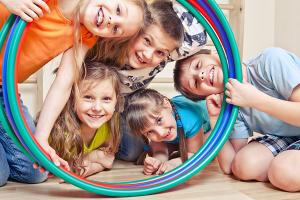
In the Hula Relay game, participants run around an obstacle course with hula- hoops lying on the ground and hoops around their bodies. What is tricky is not to step on a hula-hoop or bump into each other. The movement activity triggers students to pay attention and feel the sensation of spatial awareness. Within the Hula Relay lesson is the Home Breathlesson.
Notice in the Hula Relay lesson how participants’ outer attention changes once they feel inside their bodies. The Hula Relay lesson will introduce the Home Breath lesson. The inner attention of “Home” creates awareness of a sensory feedback that opens to the internal self. This “internal self” then balances attention with the external situation. Participants get a chance to feel the differences between how they move with each other in and out of internal awareness. It is the feeling of differences that teaches dual attention, or what is called the Sensory Body (SB), as mentioned above.
LESSON 2: WRITING FROM HOME, DUAL ATTENTION
FOR ATTENTION AND WRITING LESSONS
READING AND WRITING LESSONS: To adapt the Get Sensational Attention (GSA) program, skip the video and do the movement lessons and the User Guide . Here is the movement game for older kids – Hula Relay lesson. We use the Hula Relay lesson for GSA instead of Personal Bubbles Freeze Dance. (Reference: GSA Long Track)
a. Learn From the Home Breath
The treasure lies in the ability to feel the differences within the body to a situation. “Home” is the container, the treasure lies within the experience it.
Learn from “Home” and the “container,” and it will help guide each child on their individual way to learning.
Fourth graders and older students often need a little encouragement to become interested in their bodies. We teach them about “Home” first with the Muscle Testing lesson. To get them curious about their Sensory Bodies, and what their bodies know their minds don’t. Do a science lesson on the brain with the Muscle Testing lesson (p. 34). The lesson uses the body’s muscle strength to relate to hydration and their ability to listen. You can teach them the feeling of “Home” from the lesson, Hula Relay Personal Bubbles (58). Both lessons are in the book A New SENSORY Self-Awareness. Important Note: You don’t have to say “Home” but you do have to make a sound.
How do the three, the body, listening, and the brain, come together? The three come together in the feeling of hydration. The brain and nerves need water to think. Neurons need ions to travel across synapses. Ions develop when there is enough water for salts to dissolve in the bloodstream. Ions are what help you learn and relay new information. The SB helps the student gauge hydration and provides awareness of physical cues that make paying attention difficult.
b. Writing Lesson: Being In and Out of “Home”
The writing prompts are designed to help students sense the opportunities for learning from their bodies rather than their brains. Whether playing from Home during physical education activities or listening and sharing from Home in a classroom, the experiences will change. How we learn, deal with social conflicts, and handle emotional reactions will all improve. Don’t believe us. Apply it and watch it happen. (See Principal Garcia’s Testimonial) If you are an adult, apply the Home breath to marital conflicts or workplace arguments. You will be astounded by the changes.
The writing prompts below are suggested to be done once a week. The rest of the week, students are reminded of what they wrote. The intention is to become aware of differences in and out of Home, or the Sensory Body. There, in the experience, the teaching begins. The key is to help them compare differences in perception and behavior throughout the day. And how circumstances change when Home is present or missing. Becoming aware of the feeling in or out of “Home” is KEY!
Week 1 of Prompts. GAIN CURIOSITY
- Have you ever gotten in trouble and not know why? What were the circumstances? Was your reaction familiar?
- Have you ever not been able to hear someone when they are speaking? What did you feel? Could you feel anything inside your body, or was attention just “out there?” At the time, was “Home” present in your awareness?
- Can you feel in your body where Home rests? Can you put your hand there, feel that area of your body, and think of another person? Don’t let go of the feeling inside. Think of someone who upset you or got you into trouble. What happens to your Home?
- Close your eyes and do the Home Breath again. Drop everything in your head down into the area where the exhalation ended. This is the place of Home. Keep feeling inside where your Home rests and ask yourself what happens with your attitude? Write about it with attention to that place in your body where the exhalation ended. For example, in Home, what changed in you, the conversation, the listening? What happened to your emotion, character, or frustration? What was important that you really needed to express? How is it expressed? Did your expressions change in Home versus out of Home?
- How can you use the experience of Home in other situations? How can you remember to be the “who” you are in Home at school? (Notice any shifts in your attitude, patience, and perception of others.) Learning from the Sensory Body can only happen through experience. Feel the shifts in attention from within your body when listening to a friend, a teacher, or a family member. What will make the difference that will help you enjoy learning?
- In summary, try this: Repeat the Home Breath and feel where your exhalations end in your body. With attention there inside (at the end of the exhalation) does your attitude or perception change? Don’t let your attention let go of Home when you answer this question.
Week 2 of Prompts: THE INSIDE YOU AND THE OUTSIDE YOU
- What do you feel in your body when you want to get away and take time out? For example, where do you feel tight? Are you breathing naturally?
- What does the tightness say? How does the breath share how you feel?
- Be honest with yourself; this is just for you to write. You don’t have to share it.
Week 3 of Prompts: HOW DOES THE “YOU” CHANGE IN AND OUT OF “HOME”?
- What do you do when you are mad at someone and don’t want to talk with them?
- Were you in or out of “Home” when you got mad?
- Do the Home Breath again and see if you can keep your attention on the place where the exhalations end inside. As you write, feel from Home and share what made you mad.
Important: If you lose the feeling of Home, stop writing and pause. When you can find Home again, write from there. - Do you notice when you leave Home? How can you remember? Ask others to help? Share how to find Home with others? Ask your teacher to remind you? Wear a string around your wrist?
- Who do you like better, the person in or out of Home? Why?
Note to the Teacher: Each student’s exhalations and where it ends in their bodies will differ. The reason is muscle tension. Muscle tension relates to character and behavior.
LESSON 3: MORE ABOUT TEACHING THROUGH THE BODY
See the lessons, Muscle Testing in book and Pancake Body.
If you need more physical activities with your students, check out the book. We can alwoy help you adapt WTM to your course curriculum. Write us: contact us, WE WOULD LOVE TO HELP YOU.
Lesson sequences in the book are designed to serve as building blocks for developing an extraordinary sense of the body-mind. It is the identity of the self in form. This “I” can be felt in form through the Sensory Body (SB). You will learn, just as in nature, in the sequence of lessons that the SB is first introduced through space and time. “Space” refers to both spatial awareness around the body and the perception of a three-dimensional space within the body. “Time” means the movement through space.
LESSON 4: LEARN HOW YOUR STUDENTS’ BODIES THINK
An essential aspect of teaching about the SB is to reflect on how the feelings generated by each lesson build upon one another. The sense of union between attention directed outside the body and attention focused inside the body is what fosters SB awareness. This type of dual attention is the ultimate goal for healthier functioning.
Watch how they are breathing. The manner of breathing is the primary indicator of internal conflict. Once students can experience a type of dual awareness, the breath can alert them, long before the brain is aware. For example, if a student feels stiff-chested and is unable to breathe due to anger, frustration, or a lack of understanding, it is easier to notice the change in breath than the emotion. The Sensory Body tells the person, “Hey, my chest is tight. Oh, I am not breathing! Something must be wrong.”
If you have a mindfulness lesson, try it. Then ask the students to notice if they are breathing easier? And if so, does it feel like they have “slowed down?” For example, Anger is going fast. At this point, the student is directed to slow down and find Home. The difference in feeling between listening from a stiff ribcage and not breathing, versus feeling a soft ribcage and the natural flow of the breath, is an amazingly simple way to adjust one’s attitude.
Sense the Sensory Body with anger: Students who are angry, frustrated, or confused did they stop breathing? As a result, either attention or listening becomes confused, and fidgetiness returns. The goal is to help the student realize that their attention is solely focused on the “outer world,” and their inner presence is removed from the situation.
If a behavior reoccurs, they’re in a pattern. And if the behavior is familiar, the student has to slow down. They need to pause. A pattern cannot change without taking the time to slow down and reflect. One effective way to slow down is by focusing again on breathing. Please encourage them to wait and notice where their exhalations end or what breathes them. From this place of awareness with the breath, ask them to listen without letting go of their breath. This state of being is what we refer to as the person being in “Home.”
The union of mind and body is what the breath reveals. Insights and inspirations come from learning what the body is saying the mind doesn’t know. Now, in awareness, the student has a choice and the ability to share with the teacher what is happening for them. The teacher can then guide them into the process of doing the Home Breath lesson.
The treasure of the whole process is to get the student to notice how a situation is handled differently in or out of the Home. If they are always connected to their breathing and recognize inner challenges earlier on without reactions, choices in how their life unfolds will change for the better.
Want more?
Sign up for mailing list or contact us. We will send updates of lessons for older children and how we changed behavior through motion. Other pages you may want to look at are: Scientists, Educational Teachers, and the Parent pages.